
A platform migration can improve ecommerce performance, but it can also damage organic visibility if SEO is treated as a secondary concern. Whether you are moving to Shopify Plus from Magento, WooCommerce, SFCC, or a custom platform, platform migration SEO should be planned from the beginning.
Search engines do not automatically understand your new site structure, your changed URLs, or the relationship between old and new content. If redirects are incomplete, metadata disappears, canonicals are wrong, or content quality drops, rankings can decline quickly.
Why SEO drops happen during migrations
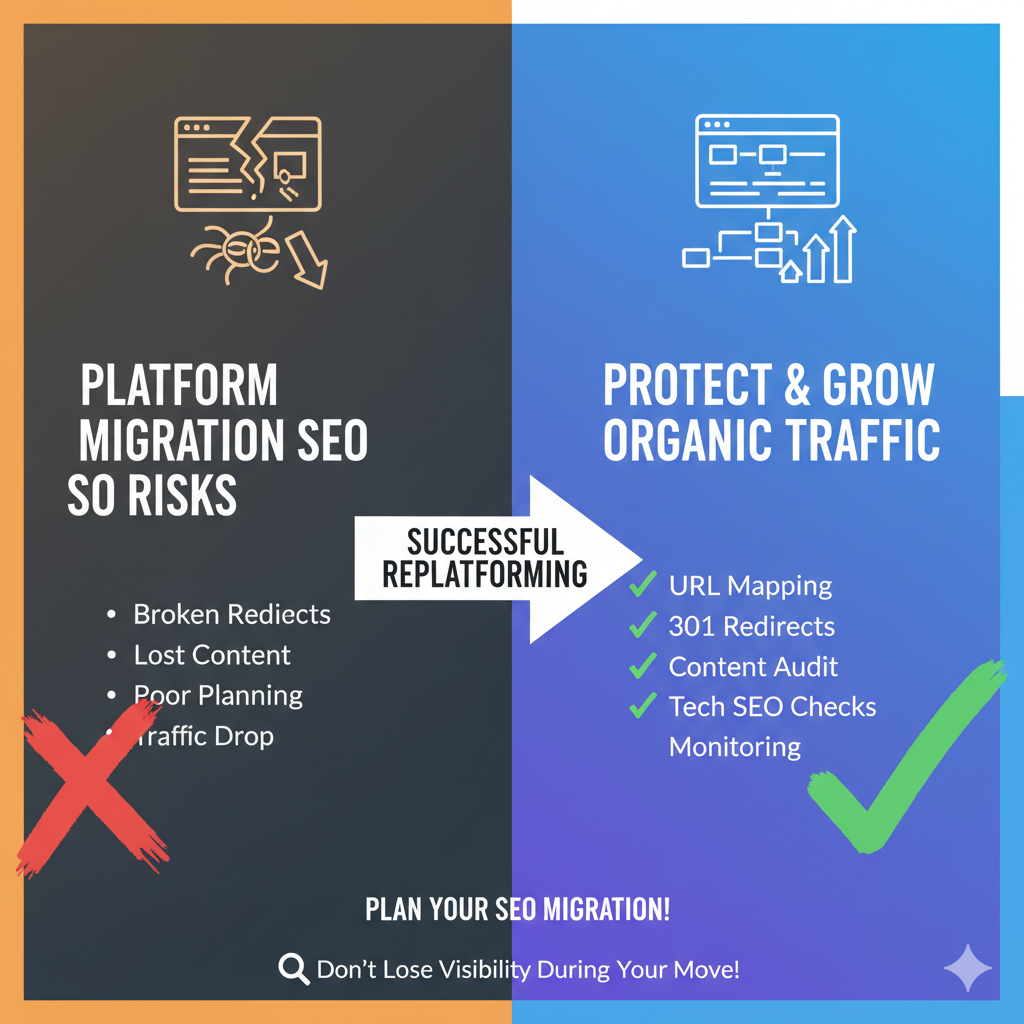
SEO losses usually come from avoidable implementation issues. Common causes include broken redirects, deleted content, missing metadata, internal link issues, duplicate content, noindex errors, poor canonical logic, and weak post-launch monitoring.
Start with a URL inventory
Build a list of every important indexable URL on the current site. Include top-performing product pages, collection pages, blog content, landing pages, and evergreen guides.
Map every important page
Each important URL should have a clear destination on the new platform. Redirect users and crawlers to the most relevant equivalent page, not just the homepage.
Preserve content quality
Do not let the migration weaken your content. Maintain valuable copy, titles, headings, category text, FAQs, and internal linking structures where possible.
Protect technical SEO elements
Review title tags, meta descriptions, canonical tags, schema markup, robots directives, XML sitemaps, pagination behavior, hreflang if relevant, and image alt attributes.
Implement 301 redirects correctly
Redirects are the backbone of replatforming SEO. Test them before and after launch. Avoid redirect chains, loops, and mismatched destinations.
Check internal links
Migrations often leave behind hard-coded internal links pointing to old paths. Update them systematically.
Verify analytics before launch
Make sure analytics, Search Console, conversion tracking, and event measurement are ready before the new site goes live.
Monitor after launch
After launch, watch crawl errors, impressions, clicks, rankings, indexed pages, log anomalies, and landing page performance closely.
Final thoughts
Protecting rankings during a migration is less about tricks and more about discipline. Strong SEO migration planning preserves hard-earned visibility while giving the brand room to grow on a better platform.